
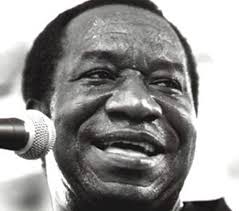
Africa has lost one of her greatest sons, the singer, songwriter and politician Pascal Tabu Ley, aka Rochereau, who passed away, in Brussels, Belgium, on the 30th of November 2013. His musical career had such an impact on Africa that he is considered by many observers as arguably the most powerful personality, alongside Mobutu Sese Seko, of the mother continent from her independence in early 1960s to the late 1980s. Who is Tabu Ley?
He is born in 1940, in Bagata, in the Bandundu province, Democratic Republic of the Congo. He can be remembered as the king of the African rumba, which he brought to perfection from his spiritual father Joseph Kabasele Tshiamala, aka Grand Kalle or Kalle Jeff, the genitor of the Congolese modern music. Curiously, Rochereau integrated Grand Kalle’s African Jazz on permanent basis only in 1959, after he had completed high school, though before integration, he was involved in the band in the composition of songs for the boss. He stood out of the lot of Grand Kalle’s spiritual sons (Doctor Nico Kasanda, Baroza, Depuissant, Serge Essous, Isaac Musekiwa, and many more) as the King of African rumba. Apart from his exclusive assets (a prolific songwriter and a showman), and dowered with educational know-how in terms of management and discipline, he imitated the father in four aspects: he was a great visionary, a skilled bandleader, a lead singer, and a politician. We shall describe his greatness by analyzing these indicated qualities.
1. Tabu Ley was a great visionary. He was animated by a great ambition to take the entire world by storm, to become a global icon. This ambition materialized throughout the unfolding of his career. After merely four years of evolving in the African Jazz as a permanent singer, he realized that his remuneration was too small compared to his huge potential. Then he decided to break away from the orchestra and, along with Doctor Nico, he found African Fiesta in 1963. Thereafter, feeling that he was born a leader, and tired of living under Doctor Nico’s shadow, he split with him to create African Fiesta National in 1966.
His dream of becoming a global superstar started to be a reality with his historic performance in the Paris Olympia Hall in 1970 (he is the first person from the African soil to have the honour to perform on such a mythic stage): “26 performances in 18 days”, according to Rick Vanderknyff (“Stange Land: Pop music: The ‘African Elvis’ left Zaire in 1988 for political reasons”, The Los Angeles Times, August 21, 1995). It was soon followed by a shorter performance in the London Palladium. By then he had been already Africa’s most popular musician; and, basking in the international glory, he adapted his band to his new status by rebaptizing it Orchestre Afrisa International (Afr = Africa, isa = the designation of his record label Isa, and International = the international scope of his fame). Furthermore, with Afrisa International, he flied even higher from glory to glory, thanks to songs such as Abidjan, Kaful Mayay, Kiyedi, and Sorozo. He reached the vertex of fame in the 1980s with the incorporation into Afrisa International of a young singer named Mbilia Bel (who became Africa’s first transcontinental diva), well renowned for hits such as Beyanga, La beauté d’une femme, and Twende Nairobi.
Last, by 1988, after divorcing Mbilia Bel and having been waning on the Congolese stage (with the fans embracing the Wenge-led faster rumba in late 1980s), Ley chose to stay in the USA as a political exile. He grabbed the opportunity to completely fulfil of becoming the global superstar by conquering the American market with the mixing of his rumba style with the samba style and the world music; and he reaped a big success, which was compounded by his traditional singing in many languages (including English), just as he learnt from Grand Kalle. This achievement was marked by the recording of two albums for Rounder Records, a label based in Cambridge, Massaschusset: the first, Muzina, released in 1994, was huge success in America and in Africa; whereas the second, Worldwide Africa, released in the fall 1995, is the new version of his classic songs, destined to celebrate the 35 years of his professional career (Rick Vanderknyff, ibid). It got crowned with not only a considerable demand of his music in the US market (Ley is the first Congolese to conquer America in such a manner) but also intercontinental tours, starting with his band playing “a steady stream of clubs, concert halls and festivals in the United States” to culminate with concerts in Europe, Africa and Japan (Ibid). Which is why he was proclaimed “global icon” by the international music chroniclers in 2000.
2. Ley was a skilled bandleader. Naturally, he is the torchbearer of the African jazz school after the Grand Kalle’s eclipse in the 1970s. This school (i.e. the “classic” rumba, which is different from the “odimba” rumba of Franco Luambo’s TP OK Jazz) is marked by Doctor Nico’s pivotal role of his solo guitar genius. However, Rochereau understood the mood of the late 1960s—which was dominated by the rock and pop music with their hot, outdoor mass concerts—and brought innovations to the classic rumba. These innovations, as Graeme Ewens put it, “included a fanfare introduction, fancy arrangements with lots of brass and dynamic changes of pace, choreographed steps for the musicians, and a troupe of female dancers” (Africa O-Ye: A Celebration of African Music. With an Introduction by Manu Dibango, London: Guiness Publishing, 1991, p.135). Moreover, he is the author of a two-phase rhythm: the first phase being of the vocals and chorus, while the second (climactic, trance-like point) being of dance. In the same token, he is the father of showmanship, which younger generations brought to higher levels, to the delight of African music lovers. These innovations revolutionized music in the continent, bringing into it the tropical heat, and adapting the western frenzy to the needs and sensibilities of the local music lovers. They gave birth to a new generation of the Congolese music with the creation in 1969 of Zaïko Langa Langa Nkolo Mboka, which arose on stage with a funky version of rumba called soukous by western chroniclers. In addition, his leadership skills allowed him to be elected president of SONECA, Congo-Kinshasa’s (Zaire) performing rights society, by 1977.
3. Ley was a prolific songwriter. In this respect he surpasses all the musicians in the history of the Congo’s music industry, including the Grand Kalle. He reportedly released 3000 tracks, almost all of them being hits. These songs wielded impact even beyond Africa’s borders not only for their exotic nature (bringing Africa’s tropical heat to the cold North), but also because, being sung equally in French, English and Spanish, their message could be perceptible in wider audiences of the West, as is typified by the hit Petite Rivière (adapted on a poem of Leopold Sedar Senghor) wherewith he commenced the Olympia concert. Besides, another of his powers lies in the diversity of his thematic. Thus, apart from the depth of the lyricism of the love songs, some songs are master strokes in describing the beauty of foreign cities, such as Abidjan, the economic hub of Cote d’Ivoire, in Abidjan, and Nairobi and Mombassa, in Twende Nairobi. Others exalt values of the African woman (like faithfulness in marriage for the sake of family stability despite the husband’s sexual vagrancy outside the wedlock), as championed in Beyanga; the higher position of the first wife in a polygamous marriage in La beauté d’une femme); a campaign against forced marriages in Africa, in Kaful Mayay (go ask Mayay), about the perils of arranged marriage; and the death of a man and the way his surrounding world behaves in its aftermath, in Mokolo nakokufa.
4. Ley was a lead singer. This is another asset which confirmed his charisma among peers, subordinates, and fans. Like Kalle Jeff his first voice (tenor) was dominant in the orchestra, though, unlike his spiritual father’s, it was somewhat trembling, alternately getting sharper and deeper—which brought magic to his singing. That is why he was able to electrify any audience in the world. Moreover, his leading voice was a factor in the stability of Afrisa International, his band, because his lieutenants, like the fans, were subjugated in awe and easily yielding to his discipline, like soldier to their captain; otherwise, many could have grown proud and leave the band. Last, this exceptional singer was the uppermost inspiration for younger singers, such as Papa Wemba, Bimi Ombale, Evoloko, Manda Chante, Ferre Gola, and Fally Ipupa, who enjoy imitating him.
5. Ley was a politician. He followed in the footsteps of his spiritual father Kalle Jeff, who released militant songs, such as Indépendance Cha Cha, Lumumba and Bilombe ba gagner, and eventually got nominated Secretary of Information in the first post-Independence government of Lumumba. President Mobutu condemned Rochereau to exile in 1988 for becoming critical to his regime. His 1990 album Trop c’est trop (It is too much) was banned as subversive. After the overthrow of the Mobutu regime by Laurent Kabila in 1997, he returned to the Congo to become a political actor. He was co-opted member of parliament in 1999, and in 2005 he was appointed deputy governor of the City-province of Kinshasa, the country’s capital—a position devolved to his party, the Congolese Rally for Democracy by 2002 peace agreement. This proves that, aside from entertaining people, Rochereau was devoured by the dream of a better Congo, which is a hegemon, or a powerhouse, in the heart of Africa. And he dared to express that dream through the song, at his risk. Certainly, the current lot of the DRC musicians must learn this from him and ennoble their singing by adding to the traditional love songs militant hits for the awareness of the Congolese people on their human, civil and political rights. Only in this way can they be an engine of change in the DRC, just as were Miriam Makeba, Lucky Dube, Yvonne Chaka Chaka, and Hugh Masekela in the change of South Africa from apartheid to democracy.


More Stories
Kinshasa Celebrates Women’s Month with Cultural Event Honoring the Leadership of Fifi Masuka
A Family Forced Into Hiding for Demanding Justice After the Assassination of Muke Mashia Hugo in Kinshasa
Dr Mukwege – DRC First Nobel Prize Winner, Hero in Panzi