

In the Democratic Republic of the Congo, political insecurity and allegations of silent repression continue to fuel fear among many citizens. Behind official speeches promoting the rule of law and democracy, numerous families describe a climate of intimidation, threats, and abandonment in the face of a justice system perceived as incapable of protecting victims when cases involve politically sensitive matters.
The case of Mr. Muke Mashia Hugo, who was assassinated on the night of October 26, 2025, in Kinshasa at Avenue Mbaya No. 19 in the commune of Mont-Ngafula, has become a striking example of growing concerns surrounding political violence, the tracking of critical voices, and the vulnerability of families seeking justice.
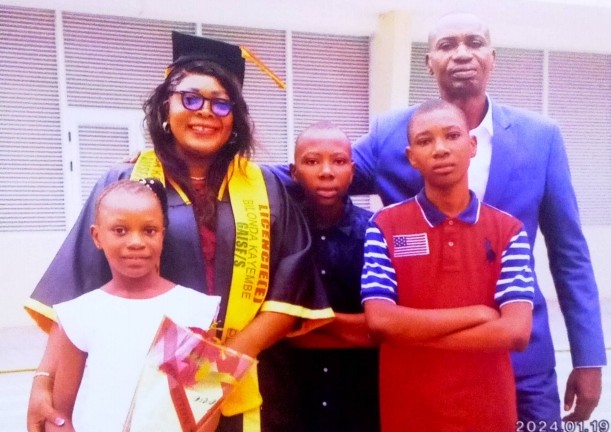
More than six months after the tragedy, his wife and their three children are reportedly still living in hiding, without a permanent address, after allegedly receiving threats and intimidation following the legal actions they initiated after the murder.
A Nighttime Assassination
According to information gathered from relatives of the family, Mr. Muke Mashia Hugo was killed around 2 a.m. at his home in the Musangu neighborhood of Mont-Ngafula, Kinshasa.
Armed men reportedly broke into the family residence while everyone was asleep. His wife and their three children Daniel, Nathan, and Divina are said to have witnessed the attack in a scene of terror.
An employee of the Rural Health Directorate (SANRU), Mr. Muke Mashia Hugo was described by those close to him as a man deeply engaged in social and political debates. In private conversations as well as in some public statements, he regularly denounced human rights abuses and the climate of political intimidation observed in the country.
According to several testimonies, he also expressed concern regarding the activities of the “Forces du Progrès,” a structure associated with the ruling UDPS party and frequently accused by citizens and civil society actors of exerting pressure on opposition figures and critical voices.
No official conclusion has established a political motive behind the assassination. However, for the victim’s relatives, the context surrounding Mr. Muke Mashia Hugo’s life before his death continues to raise serious questions.
A Search for Justice That Became Dangerous
Following her husband’s assassination, his widow initiated legal proceedings in an attempt to obtain answers and seek justice.
But according to statements from family members, these efforts quickly triggered alarming reactions. Threats, intimidation, and pressure allegedly began targeting the widow, making her security situation increasingly dangerous.
“Everything turned against her after she started speaking out about what had happened,” said a family member who requested anonymity.
According to multiple testimonies, the mother gradually realized she could no longer rely on the institutions supposedly responsible for protecting her. Fearing for her safety and that of her children, she was reportedly forced to flee her home and move regularly between temporary shelters.
Today, the family is said to have no fixed address.
The widow and her children are reportedly living in secrecy in order to avoid being located by those they believe are responsible for the threats they received.
A Life Marked by Fear
The family’s daily life is now reportedly dominated by constant uncertainty.
The children, Daniel, Nathan, and Divina, have spent months living in complete instability. According to relatives, they continue to suffer psychological trauma from the night they witnessed their father being killed before their eyes.
The trauma of the assassination has gradually evolved into another form of suffering: living in hiding, deprived of social, educational, and family stability.
Their situation highlights the vulnerability of many Congolese families confronted with sensitive cases involving security, politics, and justice.
In Kinshasa, activists, journalists, and members of civil society have for years denounced what they describe as a climate of intimidation targeting individuals critical of the government or influential political structures.
The Phenomenon of Surveillance and Silent Repression
In several neighborhoods of the Congolese capital, citizens claim they live in fear of being monitored or identified because of their political opinions.
Accusations of surveillance, anonymous calls, harassment, and discreet monitoring frequently appear in testimonies from opposition figures, activists, and families involved in sensitive cases.
According to several observers, the most troubling aspect remains the silent nature of these practices.
Unlike visible forms of repression marked by mass arrests or public violence, some modern methods of political pressure allegedly operate in the shadows: discreet intimidation, indirect threats, social isolation, psychological harassment, and targeted violence.
This climate of fear has reportedly pushed many citizens toward self-censorship.
In numerous families, people are now advised to avoid political discussions in public or on social media.
“Forces du Progrès” at the Center of Criticism
The name “Forces du Progrès” frequently appears in accusations related to political violence and intimidation in Kinshasa.
Citizen movements and several civil society actors have already denounced the conduct of this structure associated with the UDPS, accusing some of its members of acting as a parallel force tasked with intimidating opposition figures and critical voices.
Authorities and leaders of the ruling party have repeatedly rejected these accusations.
However, according to many observers, the absence of independent investigations into political violence continues to deepen public mistrust.
In a democracy, several human rights defenders argue, no political group should be associated with practices of terror, surveillance, or repression against citizens expressing dissenting opinions.
A Contested Justice System
The case of the Muke Mashia Hugo family also raises broader concerns regarding the state of the judicial system in the DRC.
Many civil society organizations have long denounced the difficulties of accessing an independent justice system in politically sensitive cases.
When victims claim they fear the very institutions meant to protect them, public confidence in the state is deeply undermined.
For the widow of Mr. Muke Mashia Hugo, Mrs. Bilonda Kayembe Mizou, justice now appears to have become an additional source of fear rather than a place of protection. Mrs. Bilonda is also a member of Amnesty International.
An Appeal to the International Community
In light of the situation, several voices are calling on international human rights organizations and international media to pay close attention to the case.
Amnesty International, Human Rights Watch, the United Nations, the African Union, religious organizations, and African NGOs are being urged to strengthen their monitoring of political violence and violations of fundamental freedoms in the DRC.
A Case That Has Become Symbolic
Beyond the personal tragedy, the story of this family has become, for many observers, a symbol of a deeper unease currently affecting Congolese society.
Fear of speaking out, mistrust toward institutions, and a growing sense of political insecurity appear to be spreading across several parts of the country.
For many Congolese citizens, one central question remains:
Can a citizen still denounce injustice or express a critical opinion without putting their own life and the lives of their family members at risk?
In the streets of Kinshasa, this question is increasingly whispered in a climate where silence itself seems to have become a condition for survival.


More Stories
Kinshasa Celebrates Women’s Month with Cultural Event Honoring the Leadership of Fifi Masuka
Dr Mukwege – DRC First Nobel Prize Winner, Hero in Panzi
Better Life for All campaign: Awareness, mobilization and prevention for environmental affairs